Summer fires in Sicily: Living with wildfires on the island
For most visitors, Sicily is remembered for its sunshine.
The golden light on honey-coloured churches, the silver-green olive groves stretching across the hills, vineyards marching in neat rows towards the horizon, and the scent of citrus blossom drifting through the spring air. It is an island of extraordinary beauty, where life seems to unfold at a gentler pace than elsewhere in Italy.
Yet there is another side to the Sicilian summer.
Every year, as the temperatures climb into the high thirties and beyond, rural families begin watching the horizon. Not for spectacular sunsets, but for smoke.
Living in the Sicilian countryside has taught me that fires in Sicily not simply an occasional natural disaster. It becomes another season. Everyone knows it will arrive. The only question is where.
Some years are kinder than others. This year has been particularly difficult. Thousands of acres have burned across the island, reducing olive groves, almond orchards, vineyards and orange groves to blackened earth. Only this week, a local man tragically died from smoke inhalation while attempting to extinguish a fire he had started himself. It was a heart breaking reminder that once a fire escapes, it belongs to nobody.
Like many rural families, we watch every plume of smoke with quiet apprehension.
Our own farm lies close to the coast, surrounded by just over two hundred olive trees and large eucalyptus trees. Our lavender fields fill the air with fragrance throughout the summer months. It is one of my favourite plants, but it also contains highly flammable oils. During the hottest weeks of the year I no longer admire it without also seeing the risk it represents. Living here changes the way you look at the landscape. You begin to notice what might burn as much as what might bloom.
Twice last summer, fires came dangerously close to our property. We have no immediate neighbours, which makes country life wonderfully peaceful most of the year. During a wildfire, however, that isolation suddenly feels very different. There is no one next door to notice the flames first, no nearby hosepipe, no reassuring knock at the gate to say help is already on its way.
The first fire began some distance away before the wind carried it towards a neighbouring property whose owners only return occasionally to tend their olive trees. I phoned the fire brigade and waited. After an hour, with no sign of anyone arriving, I called again. By then the fire had changed direction and was threatening our own land.
Frustrated, I posted a message on a local community page asking why no emergency crews had appeared. Within fifteen minutes my telephone rang. It was the local fire chief.
He apologised.
When I had first called, every available crew was already fighting fires elsewhere on the island. Later, when units finally became available, they had no water left.
That conversation has stayed with me ever since. It wasn’t an excuse; it was simply the reality of fighting dozens of fires simultaneously across an island that already struggles with water shortages every summer.
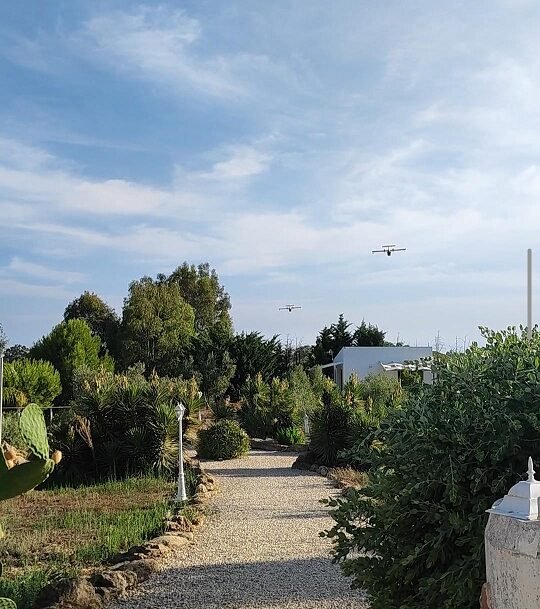
Two seaplanes flew over the house last year to the nearby coastline to scoop up water and return to the burning hills to smother the fires that were now beyond the ability of the local fire brigade.
In town, earlier this year, a fire started in a warehouse. The fire brigade were called, but they didn’t have enough water. Instead, a local contractor supplying customers with drinking water drawn from deep wells was called on to bring his tanker and supply the water the fire brigade couldn’t provide.
Water is, perhaps, Sicily’s greatest paradox.
During the winter, heavy rains fill rivers and reservoirs, yet much of that precious water eventually flows back into the sea. By August, restrictions become commonplace. It is not unusual to see people queueing beside public taps with containers and jerry cans after their household water supply has been interrupted.
When we bought our farm, becoming completely independent for both water and electricity wasn’t part of the original plan. It became a necessity. Our well reaches an underground water source close enough to the coast that the water is naturally saline. An extensive reverse osmosis system now removes the salt before it reaches our taps or the vegetable garden.
The first year we were here, I tried watering the garden directly from the well not realizing the water was salty.
The vegetables struggled almost immediately. Young fruit trees failed to establish themselves. Plants that should have flourished remained stunted and unhealthy. It was an expensive lesson in understanding the land I now call home.
Fires are woven into that landscape too.
Coming originally from South Africa, I understand the principle of controlled burning. Used carefully, it can reduce fuel loads and protect larger areas from catastrophic fires. What surprised me in Sicily was discovering that controlled burns are often carried out on windy days. When I once questioned this, a local farmer smiled and replied quite matter-of-factly, “It’s better that way. The fire burns quicker.”
There is a certain logic to that reasoning.
Unfortunately, the wind rarely follows logic.
Fires in Sicily can begin as a small burn but can become an uncontrollable wildfire within minutes. By the time neighbours emerge to investigate the smoke, the person who lit the original fire has often disappeared, leaving the flames to take on a life of their own.
The aftermath is always sobering.
Centuries-old olive trees stand blackened against the sky, their twisted trunks still recognisable but stripped of the silvery leaves that have shaded generations of harvests. Almond orchards become fields of charcoal. Vineyards are left with skeletal vines that may never produce grapes again. It is difficult not to feel a sense of loss when you realise that some of those trees survived wars, droughts and earthquakes, only to disappear during one hot afternoon in July.
And yet Sicily has an extraordinary ability to heal itself.
When the first autumn rains finally arrive, tiny green shoots begin pushing through the ash. Wildflowers appear where only weeks before the ground seemed lifeless. The black hills gradually soften into shades of green once more, reminding you that nature is remarkably resilient, even when people are not.
Perhaps that is why, despite the fear that accompanies every summer, I still find this island endlessly captivating. Sicily has always lived with hardship. Drought, earthquakes, invasions, volcanic eruptions and fire have shaped both its landscape and its people. There is a resilience here that cannot easily be explained until you have witnessed it yourself.
Every summer I find myself looking towards the horizon more often than the sea. Not because I expect to see smoke, but because I know they are always a possibility. It is an odd way to live, but it also teaches an unexpected lesson: never to take an ordinary day for granted.
On an island where the wind can change direction in a matter of minutes, today’s peaceful countryside can become tomorrow’s emergency. Perhaps that is why Sicilians have learned to appreciate the simple pleasures so well—a family lunch beneath an olive tree, the sound of cicadas at dusk, the harvest still safely on the branches—because they understand, better than most, how fragile those ordinary moments can be.