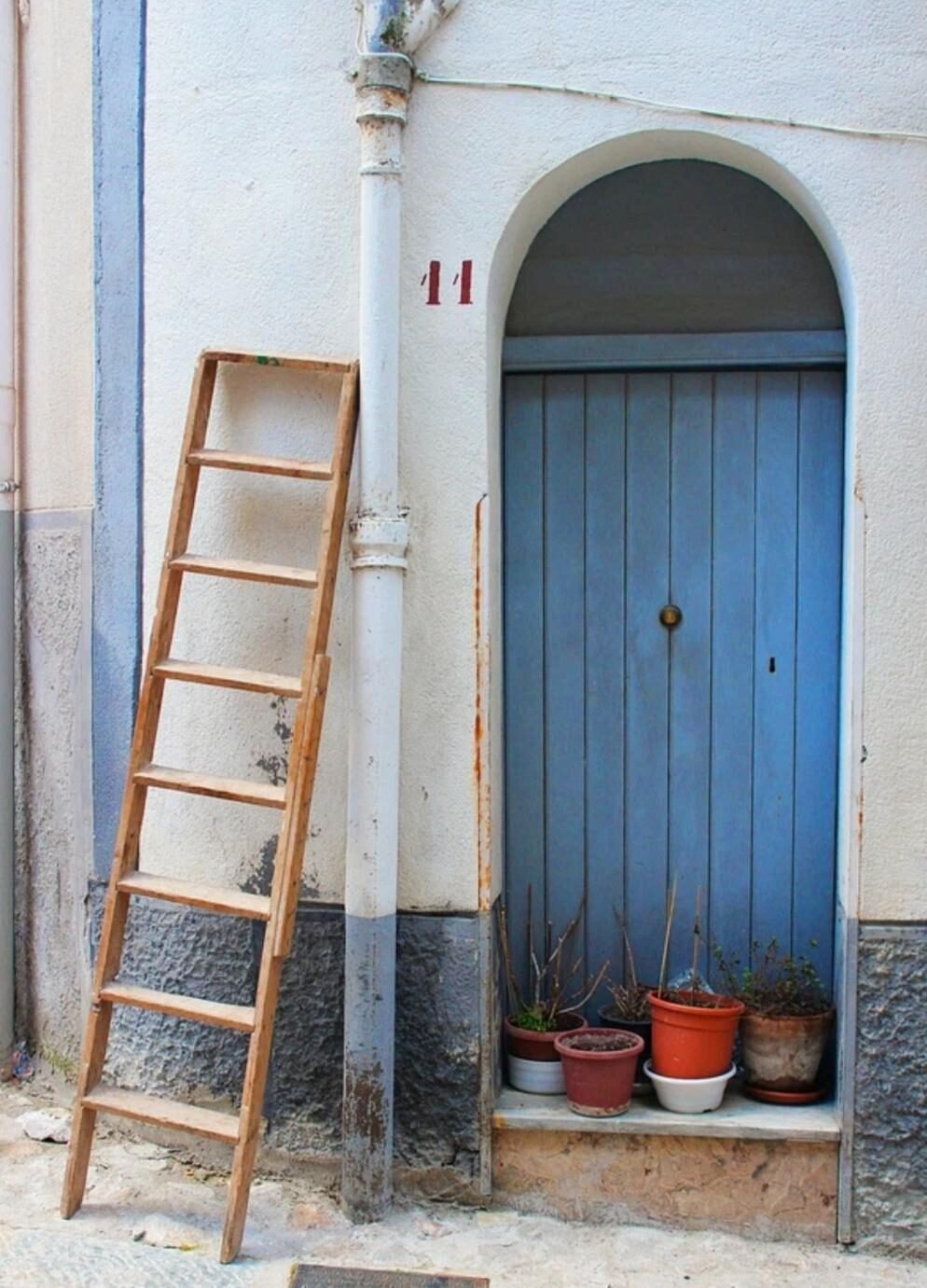
Why are so many doors in Sicily painted blue?
There are certain things you notice when you first arrive in Sicily.
The honey-coloured stone that seems to glow in the afternoon sun. Laundry dancing between narrow streets. Bougainvillea tumbling over ancient walls.
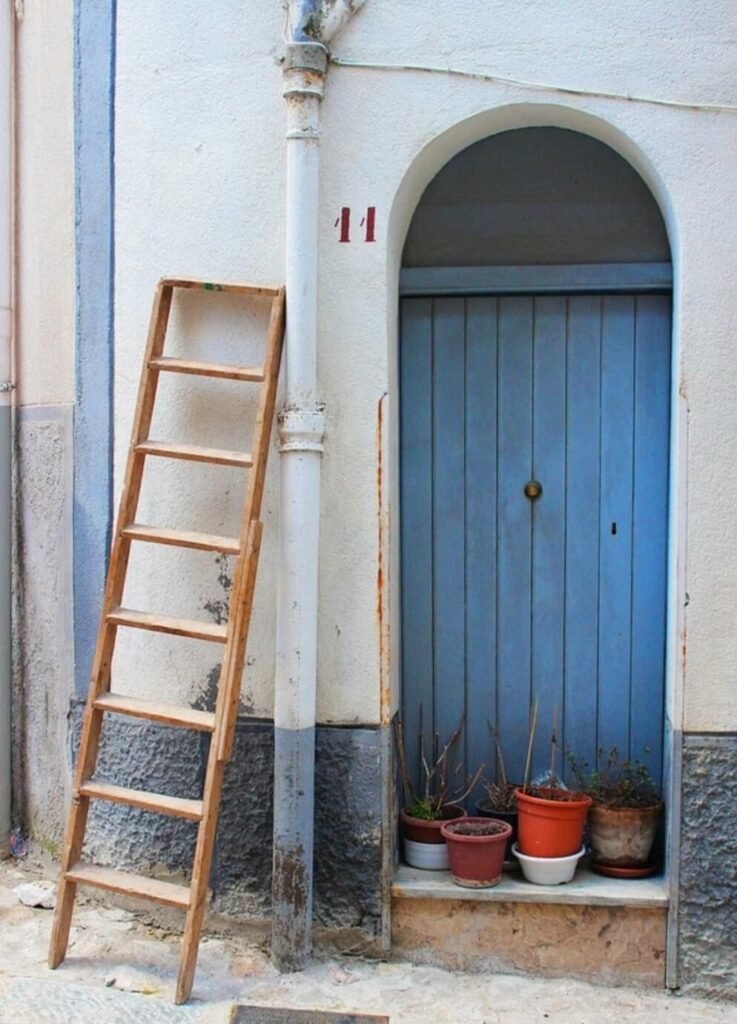
And then, quite unexpectedly, the blue doors in Sicily that seem to be the dominant colour in coastal towns and villages.
Not every door, of course, but enough of them that you begin to notice a pattern. Walk through the old quarters of Cefalù, Ortigia, Marzamemi, Sciacca or the winding streets of countless fishing villages, and blue begins appearing everywhere. Some doors are painted a deep cobalt. Others are faded turquoise after years beneath the Mediterranean sun. A few have weathered into that beautiful powdery blue that only salt air seems capable of creating.
It made me wonder whether I was looking at coincidence or tradition.
Like so many things in Sicily, the answer turns out to be somewhere in between.
There is no law requiring blue doors, nor is there a single historical event that explains them all. Instead, the colour seems to have emerged from several influences that gradually became woven into the island’s visual identity.
The simplest explanation is also the most obvious.
Sicily is surrounded by the sea.
For generations, fishing communities lived according to the moods of the Mediterranean. The colour blue became part of daily life—not only in the water and the sky, but also in the boats that filled the harbours.
Fishermen frequently painted their vessels in vivid blues, both because the pigments were readily available and because the colours weathered well in the harsh coastal climate. It seems only natural that the same paint found its way onto doors, shutters and window frames.
Yet that explanation never felt entirely satisfying.
Blue has carried symbolic meaning throughout the Mediterranean for thousands of years. Across Greek, Arab, Jewish and later Christian traditions, it was often regarded as a protective colour.
Blue glass amulets intended to ward off the evil eye were found throughout southern Italy, Greece and North Africa centuries ago. Sicily, sitting at the crossroads of those civilisations, was exposed to many of these beliefs through centuries of trade, migration and conquest, rather than through a single Italian tradition. While there is no evidence that Sicilian homeowners painted every blue door to repel misfortune, it would hardly be surprising if these ideas quietly influenced decorative choices over the centuries.
There is also the matter of ceramics.
Anyone who has wandered through Caltagirone will recognise Sicily’s love affair with cobalt blue and golden yellow. Those colours have decorated majolica tiles, fountains, churches and courtyards for centuries. The blue recalls the surrounding sea, while the yellow evokes the island’s brilliant sunshine, citrus groves and wheat fields. Together they have become almost shorthand for Sicily itself.
Perhaps, then, the blue doors in Sicily are simply another expression of that same artistic language.
Practicality may also have played its part.
Traditional pigments based on mineral blues proved remarkably durable in strong sunlight. Coastal homes endure relentless heat, salt spray and winter storms. A blue door weathered gracefully, often becoming even more beautiful as the years passed. Rather than peeling unattractively, it softened into muted shades that seemed to belong to the stone around it.
There is another possibility that appeals to me most, although it cannot be proved.
Walk through any old Sicilian fishing village and you quickly realise that these houses were never designed to impress visitors. They were built for families who spent their lives working extraordinarily hard. Their homes were modest, often consisting of only a few rooms opening directly onto narrow streets.
A brightly painted front door may have been one of the few opportunities a family had to express a little individuality.
Some chose green.
Others chose red.
Many chose blue.
Over time, as neighbouring houses were repainted in similar colours, entire streets developed a quiet harmony without anyone consciously planning it.
Perhaps we search too hard for a grand explanation.
The longer I live here, the more I realise that Sicily rarely offers simple answers. Every custom seems to be the product of Greeks, Arabs, Normans, Spaniards and Italians each leaving something behind for the next generation to adopt, adapt or quietly forget. The blue doors may owe a little to the sea, a little to old Mediterranean beliefs, a little to ceramic traditions and a great deal to simple human preference.
Sometimes history isn’t one story.
It’s many small stories layered one upon another until they become impossible to separate.
Now, whenever I wander through one of Sicily’s old coastal towns, I find myself looking at the doors almost as much as the buildings themselves. Some are freshly painted. Others are cracked, faded and worn smooth by countless hands pushing them open over generations.
I still don’t know exactly why so many are blue.
But perhaps that is part of their charm.
Not every mystery needs solving. Some simply invite us to look a little more closely the next time we pass by.

Kate
Kate writes Letters from Sicily from her coastal farm on the island, where the olive trees are heavy with fruit in October, six cats supervise everything, Fergus the Jack Russell believes every visitor has arrived especially to see him, and another letter is already beginning to take shape.

