Sicilian food through food, markets, kitchens, and daily life
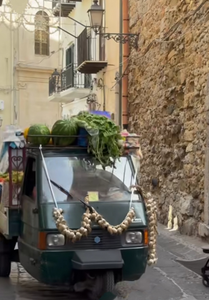
In the early hours, shutters lift across small towns and villages. Bread arrives before most streets are fully awake. A greengrocer sets crates of citrus on a worn wooden table outside his shop and begins carefully arranging them by hand, as if the order matters. To him it does.
The fruit and vegetable truck does its rounds, winding through the street, tooting its horn. The driver cries out to the housewives to alert them of his presence. There are some who come out of their houses to see what he has. They stand around and gossip while they wait their turn. The more elderly lower baskets or buckets tied to a rope with money and a note of what they want. The note is read, a smile is flashed, the goods and any change put back into the basket and it’s hauled up. A shout of thanks drifts down. Another smile is flashed. “Di nulla,” he replies.
No one calls this a tradition. It’s just how things are done here.
What food looks like here
A bakery door left open long enough for the smell to drift into the street.
A queue that forms without being asked.
Someone given a slice of cheese, or an olive to taste before they it is weighed.
A conversation continuing while coins are counted slowly onto a counter.
Markets begin before the sun has finished rising.
Fish laid on crushed ice. Herbs tied in uneven bundles. Tomatoes arriving still warm from being carried in from nearby fields. Voices move across the space loudly. These are not voices of anger. They are voices shifting between selling, asking, teasing and cajoling, greeting, remembering.
A woman folds paper around vegetables the way her mother once did. No one comments on it. It is not noticed as something special. It is also understood that you never handle the produce. That is reserved for the seller.
What is considered Sicilian food?
To a Sicilian food is life, family, culture.
In kitchens behind closed doors, food is prepared using authentic Sicilian recipes built on past cultural influence. A Sicilian housewife will get up early in the morning to prepare a few meals for the rest of the week, especially in the summer when cooking in kitchens during this time is pure torture.
Sicilian food is simple, honest, timeless – made with the freshest local ingredients possible.
Someone adds salt by instinct where pasta is always cooked in water as ‘salty as the sea’. Someone else refuses to measure the oil. It’s a glug of oil, depending on what is being prepared. A dish changes slightly depending on who is cooking it, in what region around the island, or what was available at the market that morning.
Nothing is wasted. Stale bread, if not fed to the chickens, becomes breadcrumbs for Pasta Ca’muddica or perhaps Polpette di Pane. These are fake fried meatballs with eggs, cheese and Mediterranean herbs. A dish reflecting the ingenious way of using what is available and honouring the ‘waste not, want not’ adage.
Couscous is enjoyed by every Sicilian, as is caponata which appears on most restaurant menus. Couscous was introduced by the Arabs when they invaded the island in 827 A.D. and stayed for 75 years.
Caponata is a traditional Sicilian dish that evolved to what it is today. This is an excellent example of how Sicilian food has been shaped by past cultures who lived here. It includes local ingredients like pine nuts and capers, aubergines introduced by the Arabs, and olives coming from trees the Greeks planted centuries ago when they migrated to Sicily for the fertile soil.
Whatever you eat, you know that the dish has been influenced by either the Greeks, the Romans, the Arabs, the Normans or the Spanish. The Spanish having introduced the locals to chilis and the chocolate recipes that have made Modica famous. Each culture has left their mark.
Sicilian Modica chocolate
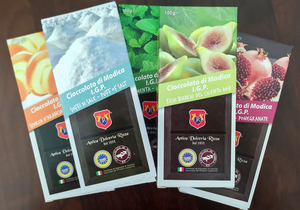
In Modica, chocolate is still made in a way that keeps its sugary grain as it did more than 500 years ago when the Spanish brought over the recipe.
Sugar does not fully dissolve. The texture remains uneven, almost brittle. It breaks differently than most chocolate people are used to. And because of the cold process, the cocoa retains a lot of beneficial elements, making Modica chocolate one of the most healthy chocolates in the world. Which should please some.
In small workshops, slabs are cut by hand and wrapped without ceremony. Some flavours return every year. Others appear and disappear without announcement.
Typical ingredients used in Sicilian food
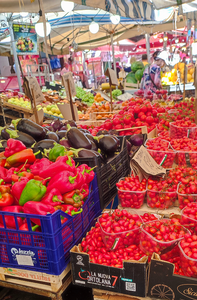
No self-respecting Sicilian housewife would not have these basics in her pantry; dried spaghetti, a method of food preservation introduced by the Arabs, yet again. Local cheeses, homegrown tomatoes, sweet peppers, aubergines, parsley and olives are basic ingredients found in Sicilian food and produced at kitchen tables around the island, daily.
Certain things appear repeatedly on tables here. The vegetables found in most Sicilian dishes are garlic, tomatoes, aubergines, peppers, and chilis. Food is usually purchased daily and everything is fresh. Most of the food grown on the island is done on small farms grown the old-fashioned way – organically. One can definitely taste the difference. I grow my own vegetables on the farm. Every year we have a bountiful harvest, although this year the summer was brutal, and with no rain for months, our harvest this year suffered.
Living on the coast, there is never a shortage of seafood on restaurant menus and at the local fish shops. Calamari, octopus and mussels are always available, and the little sardine is highly valued. Our little fishing village ten minutes away holds a sardine festival every year where one can watch them being cooked over hot coals and taste the various dishes. Sadly this year, it was cancelled. Earlier in the year we had a cyclone that devastated much of the Sicilian coastline on the western side all the way down to Catania and beyond. Our local council has not helped to dredge the port that became clogged with seagrass as a result of the cyclone, preventing many of the boats from fishing. Because work was done on the port only at a much later date, causing great financial hardship, the fishermen cancelled the festival in protest. Who can blame them?
Cedro, a large citrus fruit when in season, is sliced with a knife, sprinkled with salt, and eaten.
Almonds stored in tins and used without counting. Pistachios from volcanic slopes in the Bronte region.Capers, that put the small island of Pantelleria on the map.The large Belice olives, which grow on my farm, used for both olive oil and eating. Seafood freshly caught during the night and arrives at the markets by morningothing is treated as rare, even when it is.
Sicilian meals are not planned
Coffee is taken at the bar in the early morning while someone leans slightly on the counter. It will come with a glass of cold water, and perhaps a sweet baked confectionery. This is breakfast.
Bread is bought on the way home, at the local bakery. Always fresh.
Lunch depends on what was available earlier in the day usually cooked with pasta. It is a meal that is sacrosanct. It is not to be interrupted by phone calls or visits and it usually begins an hour after midday and can last two hours or more. All small shops and business will halt their activities to have this meal with their families. Another hour is usually taken beyond this to relax before going back to reopening their shops.
And then there is the passeggiata taken before the evening meal. A tradition involving walking around the town with your friends and family where people dress up to be seen. It is important to wear your best, because your neighbours and friends will also be partaking, and it is good to be seen well-heeled.
No casual footwear. No shorts. No beachwear.
The evening meal is eaten late. Eating at nine o’clock is not unusual. It is standard.
These are how days are shaped.
Authentic Sicilian street food markets
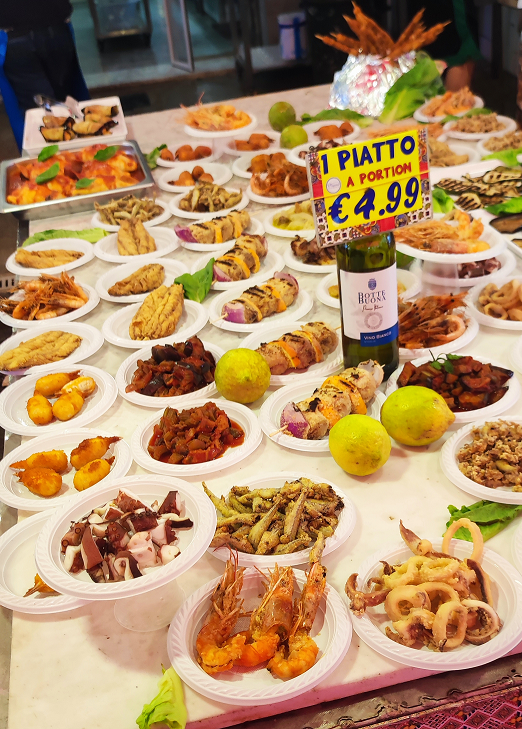
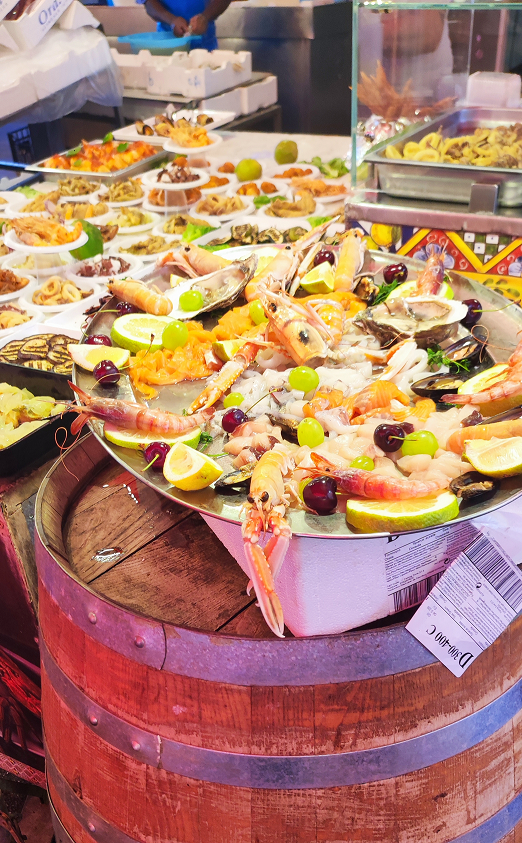
The capital of street food is Palermo. This is a window into Sicilian food that may not make the menus, and therefore a must-see if you visit the area. There is sfincione, a sponge-like pizza which is very similar to focaccia, and a number of offal dishes such as stigghiole – grilled sheep and goat intestines, and pani câ meusa – a spleen and lung sandwich with ricotta and honey just to make it palatable. These are all staples of market stalls in Palermo. The latter two I have not been brave enough to try.
I consider the Mercato del Capo and the Ballarò Market to be the best for atmosphere and photographic opportunities. Tables stretch as far as the eye can see, laden with traditional Sicilian snacks and food that can be eaten on the go. Often, it is made while you wait. Sometimes, it has already been prepared and is displayed on the tables in an array that making a choice becomes difficult.
The sellers compete with each other in raucous voices calling customers over to taste what they have on offer.
The atmosphere is electric, chaotic, memorable.
Continue exploring Sicily
Food here connects directly to everything else on the island.
- history and layered influences
- festivals and seasonal celebrations
- landscapes shaped by cultivation and climate
- towns where markets form the centre of daily life
Or receive it by post
Each month, Letters from Sicily carries stories like these — written from lived moments on the island and sent by post.
Not descriptions. Not summaries. Just what was seen, heard, and noticed.