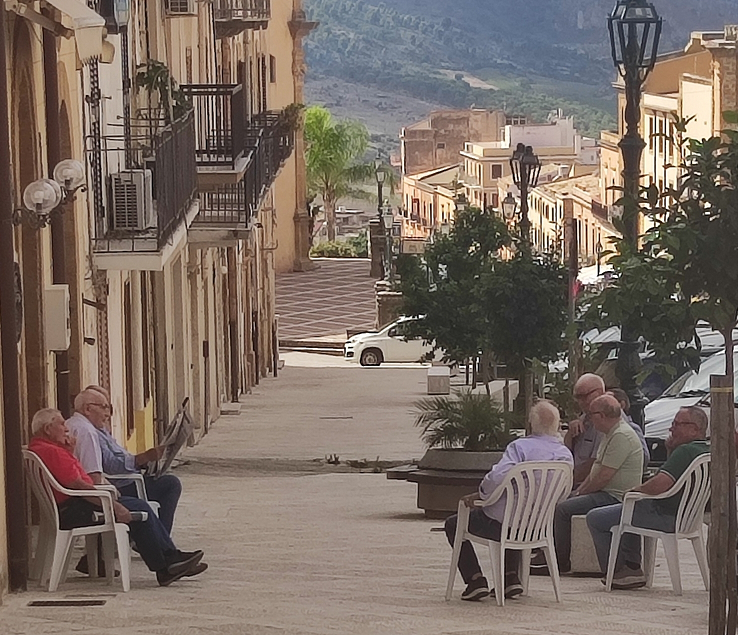
Dolce far niente: What Sicily taught me about doing nothing
Everyone knows la dolce vita. Fellini gave it to us in 1960: Anita Ekberg wading into the Trevi Fountain, Vespas, sunglasses, champagne at three in the morning. The sweet life is glamorous, a little reckless, and best lived in Rome.
Here in Sicily, people talk more about something quieter: dolce far niente, the sweetness of doing nothing.
They sound like cousins, but they’re not the same thing. La dolce vita is about having. Dolce far niente is about being. One needs a nightclub, and the other needs a chair in the shade.
An old idea
The idea is much older than the cinema. Nearly two thousand years ago, Pliny the Younger wrote to a friend from his country villa about the pleasure of doing nothing, nil agere, as something to be enjoyed rather than excused. The Romans had a word for that kind of time, otium: leisure that restores you, as opposed to the busy business of negotium. Our word “negotiate” comes from it. Literally, it means “not-leisure.”
The Italians kept the idea. The Sicilians, I’d argue, perfected it.
How Sicily does nothing
If you’ve ever tried to buy a hinge in Castelvetrano at half past two in the afternoon, you’ll know what I mean. The shutters are down. The streets are empty. It’s the controra, the hours after lunch when the heat presses down on everything and nobody with any sense does anything at all.
When I first moved here, this drove me mad. I’d spent years in Abu Dhabi, where the working day ran on schedules and deadlines, and before that I’d run a smallholding in Tuscany where there was always another animal to feed. Doing nothing felt like failing.
Then the evenings show you what the afternoons were for. At dusk, the whole town comes out for the passeggiata. Nobody is going anywhere. They walk slowly, stop to talk, have a granita or a coffee, and walk back again. It isn’t exercise, and it isn’t errands. It’s just being among people at the cool end of the day.
What it isn’t
Dolce far niente isn’t laziness, and it isn’t scrolling on your phone on the sofa. Sicilian nothing has a texture to it. It’s sitting under the olive trees after the harvest is in. It’s a long lunch where the conversation matters more than the food, though the food matters a great deal too. It’s watching the light change over the sea without feeling you should photograph it.
The sweetness comes from the fact that you’ve earned it, or simply from the fact that you’ve allowed it.
Learning it the hard way
I’d love to tell you I took to it naturally. I didn’t. On a farm there’s always something: the lavender that needs weeding, the irrigation that needs checking, the prickly pears ripening faster than you can pick them. I lost a good part of my first lavender planting when weeds pushed the irrigation tubing out of place. My first instinct was to work harder.
What I’ve slowly learned is that the land itself keeps Sicilian hours. Nothing grows faster because you fret over it in the midday sun. The olives take their time. The prickly pears come when they come. Some jobs can only be done in the early morning or the evening, and the hours in between belong to the shade.
Bringing a little dolce far niente home
You don’t need eighteen acres in Sicily to practise a little dolce far niente, nor do you need to feel guilty when you do! A few ways to start include:
- Take a real lunch. Sit down, away from the screen, and take longer than you think you should, preferably with friends or family.
- Find your controra. Pick one part of the day, even twenty minutes, when you deliberately do nothing productive.
- Walk without a destination. Your own passeggiata, ideally with someone to talk to. This could be a walk on the beach, through a park, or even around the block.
- Stop apologising for rest. The Romans saw leisure as the purpose of work, not the reward for it.
La dolce vita is lovely to watch on film. But dolce far niente is the one you can actually live, and in Sicily I’m finally learning how.
If you enjoyed this article, you may like to join our monthly letter subscription. Or perhaps you would like to try before you buy, with no strings attached. We offer a free letter that was sent to our subscribers in August, 2026.

Kate
Kate writes Letters from Sicily, a monthly letter posted from the island to readers around the world. She writes about the places she visits, the people she meets, and the everyday moments that reveal what life here is really like. Another letter is always taking shape.

