The Greek from Sicily who changed the world
More than fifty years ago, sitting in a Southern African primary school classroom, I remember staring at a drawing of what looked like an enormous screw inside a pipe.
Our teacher explained that by turning it, water could be lifted uphill from a river into irrigation channels. To my young mind it seemed almost magical. I was captivated by its elegant simplicity and by the man who had supposedly invented it. His name was Archimedes, and like generations of schoolchildren before and since, I dutifully learnt that he was Greek. There was no mention of Syracuse, or Sicily. That bit was glossed over. The information had been burned into my brain. He was Greek. Decades went by and I never questioned further.
It wasn’t until I moved to Sicily that I discovered my schoolteacher had only told us half the story.
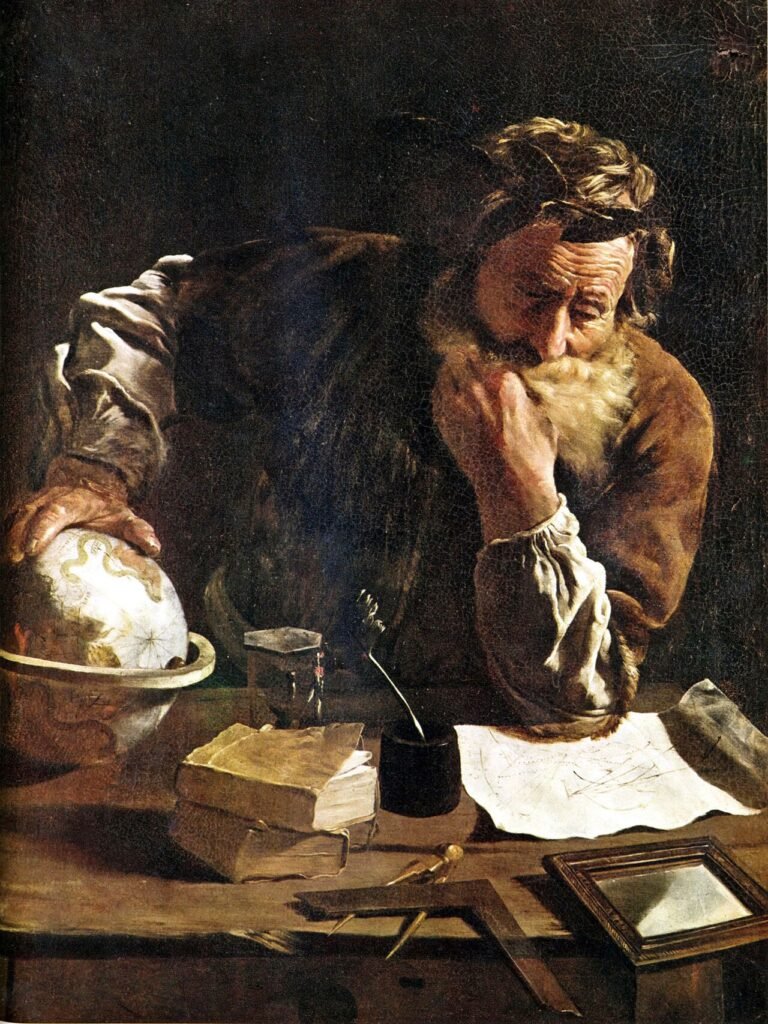
Archimedes was born in Syracuse
Archimedes was certainly Greek by ancestry and culture. But he wasn’t born in Greece. He first opened his eyes in Syracuse, on the south-eastern coast of Sicily. By then one of the wealthiest, most sophisticated cities in the Mediterranean world.
Standing on the waterfront in Ortigia today, watching fishing boats bob gently in the harbour and children chase each other across ancient stone, it is difficult to imagine that this quiet corner of Sicily was once home to a mind that would shape mathematics, engineering and science for more than two thousand years.
Syracuse had been founded by Greek settlers from Corinth in 734 BC, during the great period of Greek colonisation across southern Italy and Sicily. This was a region that became known as Magna Graecia, or Greater Greece. By the time Archimedes was born, around 287 BC, Syracuse rivalled Alexandria and Carthage as one of the largest cities in the known world. Merchant ships crowded its harbours, markets overflowed, and its rulers invested heavily in temples, theatres and ideas.
If there was ever a place capable of nurturing an extraordinary mind, this was surely one of them.
A mind that travelled
We know almost nothing about Archimedes the boy. His father was an astronomer named Phidias, we know this from a detail Archimedes himself mentioned in one of his writings. However, beyond that, the historical record falls silent. No mother’s name. No siblings. No street address in ancient Syracuse.
As a young man he travelled to Alexandria in Egypt, then the intellectual capital of the ancient world, to study alongside the greatest mathematicians of his age. The friendships he formed there lasted a lifetime. Long before emails or telephones, ideas travelled by ship, carried in carefully written letters across the Mediterranean. A detail that feels, to someone who posts handwritten letters from Sicily each month, rather close to home.
He eventually returned to Syracuse, but his reputation was already international.
More than the man who shouted Eureka!
Most of us know Archimedes for two stories.
The first is the screw. The second is the naked man running through the streets.
Both are worth knowing properly.
The Archimedes Screw, whether entirely his invention or a refinement of earlier Egyptian devices, remains one of the simplest and most effective methods ever devised for raising water. Variations of it are still used to irrigate farmland around the world today, more than two thousand years after it was first conceived in Syracuse.
The ‘Eureka’ story belongs to a different kind of genius. King Hiero II had commissioned a golden crown but suspected the goldsmith of secretly mixing cheaper silver into it. The challenge was to prove the fraud without damaging the crown. This was no easy task in an age without laboratory instruments.
The solution came, reportedly, while Archimedes stepped into a bath and watched the water rise around him. A submerged object displaces a volume of water equal to its own volume. By comparing the crown’s density with that of pure gold, the deception could be revealed without touching a single gram of metal.
Whether he really sprinted naked through the streets of Syracuse shouting ‘I have found it!’ is impossible to prove. But it remains one of history’s most enduring scientific legends and somehow, in Sicily, it feels entirely plausible.
The mathematics nobody talks about
If Archimedes had invented nothing at all, he would still rank among history’s greatest mathematicians.
Centuries before calculus existed, he developed methods astonishingly close to what Isaac Newton and Gottfried Leibniz would later formalise. He calculated an extraordinarily accurate value for π. He explored the geometry of spheres and cylinders. He established principles of leverage that remain fundamental to engineering.
‘Give me a place to stand, and I will move the Earth.’
That wasn’t the boast of a dreamer. It was the confidence of a man who understood the mathematics of levers better than anyone who had come before him.
Modern engineers still rely on ideas Archimedes first explored over twenty-two centuries ago.
Defending Syracuse
When Rome laid siege to Syracuse during the Second Punic War, Archimedes turned his intellect towards protecting his city. He designed powerful catapults capable of striking enemy ships before they reached the harbour walls. Enormous cranes reportedly lifted Roman vessels partly from the sea before dropping them back into the water, terrifying the sailors below.
Ancient writers even described enormous mirrors focusing sunlight onto Roman ships to set them ablaze. Historians remain sceptical. But the persistence of the story speaks volumes: to his contemporaries, almost anything seemed possible if Archimedes had designed it.
Do not disturb my circles
In 212 BC, Rome finally took Syracuse.
The Roman commander, Marcellus, greatly admired Archimedes and ordered his soldiers to bring the old mathematician to him unharmed.
One soldier found him absorbed in a mathematical problem. He ordered Archimedes to come at once.
Archimedes refused. He asked only to be allowed to finish his work.
“Do not disturb my circles.”
Whether those were his exact words, they have echoed through history for more than two millennia. The soldier, impatient or enraged, drew his sword.
Marcellus was said to have been deeply distressed when he learned what had happened. Syracuse had been conquered, but Rome had accidentally destroyed one of the greatest minds the ancient world had ever produced.
What Sicily hides in plain sight
Few people leave the world fundamentally different from the one into which they were born.
Archimedes did.
His discoveries laid the foundations for hydrostatics, mechanics and modern engineering. His mathematical methods anticipated ideas that would not be fully developed for nearly two thousand years. Every student who has ever studied buoyancy, levers or geometry is, knowingly or not, following in his footsteps.
The longer I live in Sicily, the more I realise that the island is full of stories like this one. Visitors come searching for sunshine, beaches and extraordinary food . All of which they find. What they often don’t expect is to encounter one of history’s greatest scientific minds while wandering through the streets of Syracuse.
I know I didn’t.
Now, whenever I walk through Ortigia, I find myself wondering where the young Archimedes once stood. Which harbour wall he sat upon while watching the tide come in. Which conversations first sparked the questions that would occupy his extraordinary mind for the rest of his life.
We cannot know. But we do know this: some of the greatest ideas in human history began not in Athens or Rome, but on a sunlit island at the heart of the Mediterranean.
And for a little girl who once believed Archimedes belonged to Greece alone, that turns out to have been the most remarkable discovery of all.
Would you like to know what I write about to my subscribers?
Access a letter for free that we sent out in August, 2026.