The night Palermo belongs to Saint Rosalia
There are few events in Sicily that reveal the soul of the island quite like the Festino di Santa Rosalia, honoring saint rosalia.
For one extraordinary night every July, Palermo ceases to be simply the island’s bustling capital and becomes something altogether different. Traffic gives way to processions, balconies overflow with families leaning precariously over wrought-iron railings, and every available inch of pavement is claimed hours before the great procession begins. The city, usually loud with scooters, impatient car horns and animated conversation, finds itself waiting for a single moment.
This celebration is a tribute to the beloved saint rosalia, whose spirit inspires the festivities.
The arrival of a woman who died nearly four hundred years ago.
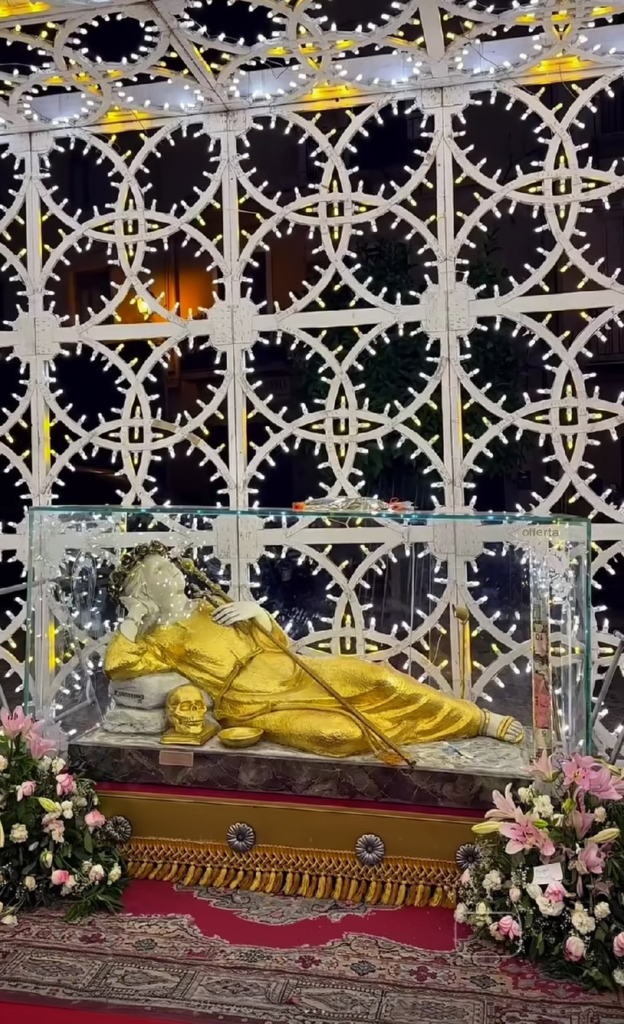
This year marked the 402nd anniversary of Saint Rosalia’s recognition as Palermo’s patron saint, a milestone that drew even greater crowds than usual. Tens of thousands of people lined the Cassaro, Palermo’s ancient main street, waiting patiently beneath the July sun before darkness finally settled over the city. Children sat on their fathers’ shoulders. Elderly women carried rosary beads worn smooth by decades of prayer, the silver chains dark with the oil of a thousand hands before theirs. Visitors stood shoulder to shoulder with lifelong Palermitani, all sharing the same anticipation, none of them quite strangers by the time the first firework cracked overhead.
To an outsider, it can seem difficult to comprehend.
Rosalia was born into Norman nobility during the twelfth century, yet chose to abandon privilege in favour of a life of solitude. She withdrew to a cave on Monte Pellegrino at the age of fourteen, where she lived as a hermit, dedicating herself entirely to prayer, and dying there alone around 1166.
It was not until centuries later — during the devastating plague of 1624 — that her story became inseparable from that of Palermo itself.
According to tradition, Rosalia appeared in visions to a sick woman and a hunter named Vincenzo Bonello. Each time the hunter approached, a white dove flew a little further ahead, finally settling at the mouth of a cave high on the mountain. Convinced, he made the journey — fifteen hundred feet up — and found the cave, and inside it, the bones of Rosalia.
When her remains were carried through the plague-stricken streets of Palermo, the epidemic began to subside.
Whether one views the story through the lens of faith or history, its effect upon the city was profound. From that moment, Rosalia ceased to be merely a medieval saint. She became La Santuzza — the Little Saint — protector of Palermo and its people. She was canonised in 1630, and the city has never forgotten what it owes her.
That devotion has never faded. There are still people today who make a pilgrimage to Monte Pellegrino to visit the cave and the shrine to Santa Rosalia.
The centrepiece of the festival is an immense ceremonial float carrying a statue of Saint Rosalia high above the crowds. It moves slowly through Palermo, not under its own power but propelled by hundreds of volunteers pulling ropes, the rope itself groaning under the weight, while thousands more walk alongside. Bands play, bells sound from every direction at once, and fireworks explode overhead, yet despite the spectacle there are moments when silence unexpectedly descends, so complete you can hear the wax dripping from someone’s candle onto the stone beside you.
As the saint passes, many people instinctively reach out towards her.
Some cross themselves.
Some whisper prayers that no one else will ever hear.
Others simply stand motionless, tears running unashamedly down their faces.
It is perhaps the most remarkable aspect of the procession. Palermo is a city often portrayed through the lens of organised crime, political intrigue and social complexity, yet on this one night those divisions appear, if only briefly, to dissolve. Respectable businessmen stand beside market traders, judges beside labourers, university students beside elderly widows. It is often said that even those living on the wrong side of the law come to honour Rosalia. Drug dealers, burglars, petty criminals and men whose names are spoken only in whispers all find themselves drawn into the same current of devotion, asking forgiveness, protection or simply another chance. Whatever waits for them on Monday morning, for one night they kneel on the same stone as everyone else.
For a few hours, they become pilgrims rather than outcasts.
It would be easy to dismiss this as contradiction or hypocrisy, but Sicily has never been a place that fits neatly into simple categories. Faith here is rarely detached from everyday life. A man might light a candle for Rosalia on Tuesday and settle a debt with his fists on Thursday, and neither act, to him, cancels the other. Many of those who walk behind Rosalia’s statue carry burdens invisible to everyone else, and perhaps that is precisely why the procession continues to hold such extraordinary power after four centuries.
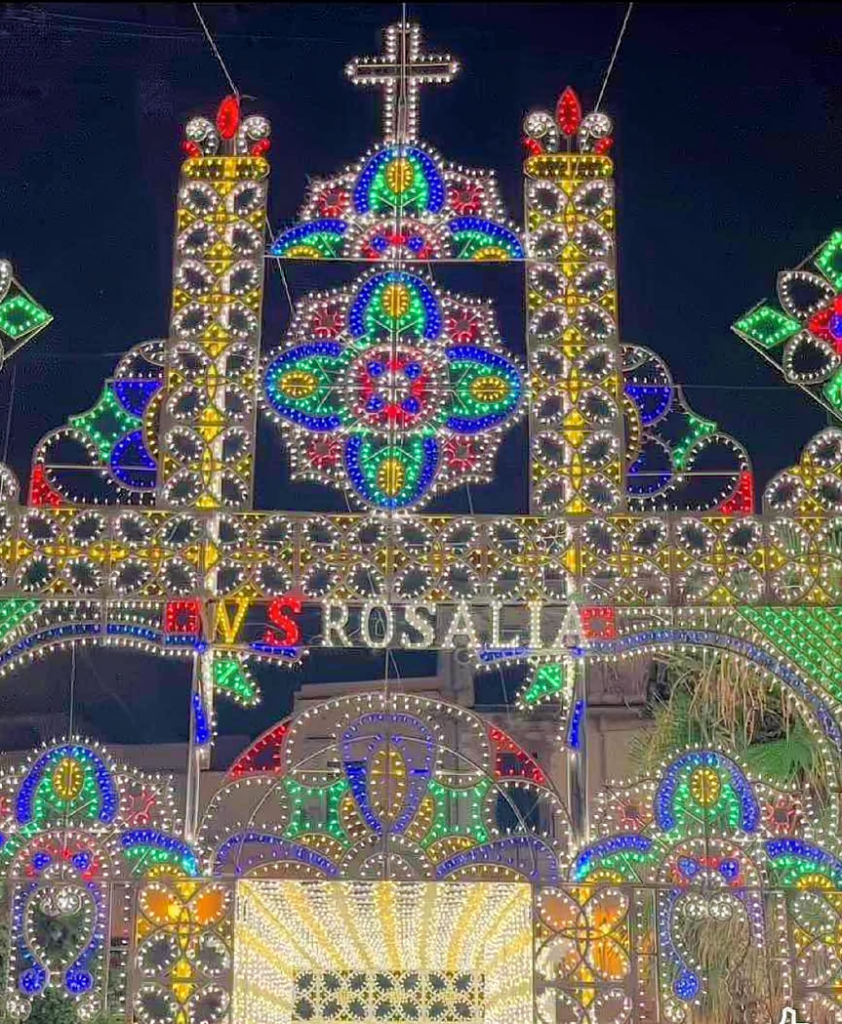
One of the more curious observations made by those who know Palermo well is that crime appears almost to pause during the Festino. Whether this is due to increased police presence, the sheer number of people in the streets, or the simple fact that so many choose to participate in the celebrations, the city seems, for one evening at least, to take a collective breath.
By dawn, however, Palermo begins returning to itself.
The crowds disperse. Street sweepers remove the confetti and discarded food containers. Shopkeepers reopen their shutters. Scooters weave once more through narrow streets. Those who wept the night before return to their businesses, their families and, in some cases, their old habits. Those who prayed for forgiveness must once again wrestle with the lives they lead.
It would be tempting to conclude that nothing has changed.
Yet perhaps that would miss the point entirely. The Festino has never promised to make anyone good. It has only ever promised that for one night, being flawed and being loved are not mutually exclusive, and in a city built on contradiction, that may be the closest thing to grace it has to offer.
If you are in Sicily in mid-July and can reach Palermo, go. Arrive early enough to find a place along the Cassaro before the crowds make it impossible. Wear comfortable shoes. Expect the unexpected as this is Palermo, after all.
And if you cannot be there in person, the letters I write each month from Sicily do their best to bring moments like this one to wherever you are.
Letters from Sicily dispatches on the first Monday of each month. Find out more at lettersfromsicily.com