Sicilian Caponata recipes have 1000 years of history
The first time I tasted a bowl of authentic Sicilian caponata, I was hooked. It was luscious, silky on the tongue, slightly acidic.
It arrived as a small side dish in a little restaurant overlooking a grey Mediterranean Sea. It was December, and one of the few restaurants still open in town. Much of coastal Sicily quietly closes down for the winter. Promenades that only weeks before had been filled with holidaymakers fall silent. Favourite cafés lock their doors, hotels empty, and many restaurants won’t reopen until Easter.
Luckily for us, this one stayed open.
Over the years it has become our Friday evening tradition, serving some of the best pizzas we’ve ever eaten.
But it wasn’t the pizza that won me over that first day.
It was the Sicilian caponata.
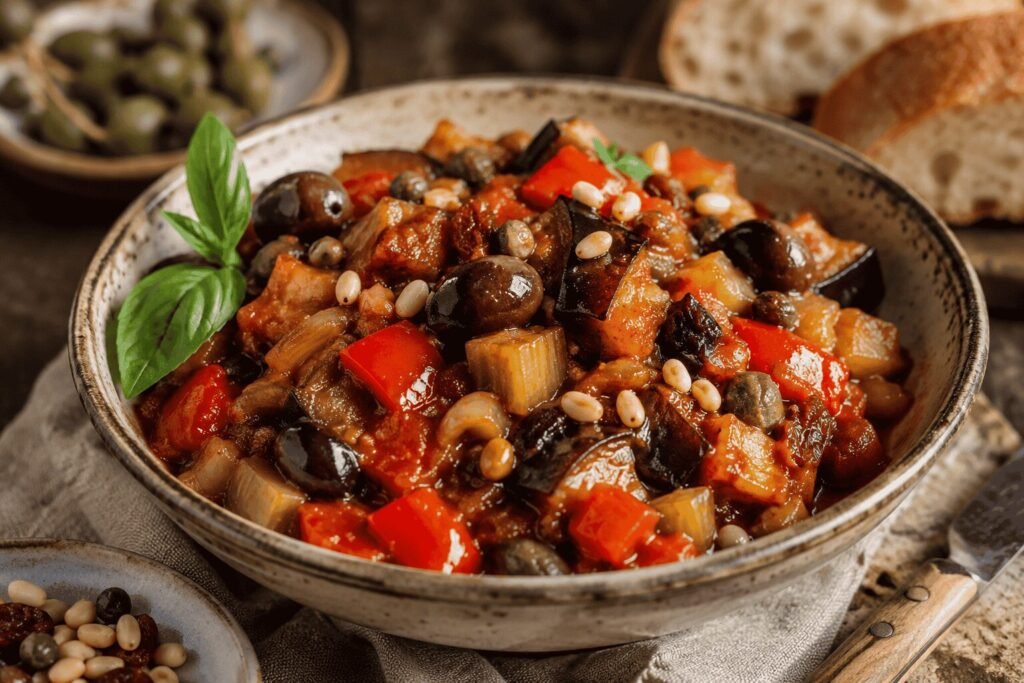
The aubergine had softened until it almost melted, carrying with it the sweetness of tomatoes and peppers. Then came the unexpected crunch of celery, followed by the richness of pine nuts, the sharpness of capers, salty olives and finally that unmistakable balance of sweetness and vinegar that somehow held everything together.
It wasn’t quite a salad.
It wasn’t quite a relish.
And it certainly wasn’t ratatouille.
People often compare the two because they share similar Mediterranean vegetables, but the resemblance ends there. Ratatouille is soft and gently stewed. Caponata keeps its character. Each vegetable still knows what it is, held together by Sicily’s famous agrodolce—its sweet and sour sauce.
That single mouthful made me realise I wasn’t simply eating vegetables.
I was eating history.
More than a thousand years on the table
Like so much of Sicilian cooking, caponata tells the story of the people who passed through the island.
The Arabs introduced aubergines to Sicily more than a thousand years ago, together with many of the ingredients that now define Sicilian cuisine. Citrus fruits, almonds, sugar cane, rice and countless spices transformed the island’s kitchens forever.
They also brought agrodolce.
Most people describe it simply as sweet and sour.
But its origins go much deeper.
The idea reaches back beyond Islam to ancient Persia and the teachings of Zoroastrianism, where opposing forces—light and darkness, sweet and bitter, life and death—were understood as essential parts of a balanced universe.
The sauce itself became an expression of that balance.
I’ve always found it remarkable that something as ordinary as a bowl of vegetables can carry with it a philosophy that travelled thousands of miles and survived for centuries.
Every town has its own caponata recipe
There isn’t one authentic caponata recipe.
There are dozens.
Food historians have documented at least thirty-seven recognised variations across Sicily, each fiercely defended by the people who make them.
In Catania you’ll often find red and yellow peppers added.
Around Agrigento, sweet local peppers appear.
Some family recipes include potatoes.
The version from Palermo is probably the best known internationally and has become the one most people think of when they hear the word caponata.
Ask a Sicilian which version is correct and you’ll probably receive a passionate answer.
Ask another Sicilian five minutes later and you’ll receive a completely different one.
Both will insist they’re right.
A dish that crossed the Atlantic
Like millions of Sicilians, caponata eventually left the island.
In 1869, the Pensabene family began preserving it commercially, followed by Palermo’s Fratelli Contorno, who carefully packed it into tins and jars before exporting it around the world.
Many of those jars found their way to America.
For Sicilian emigrants building new lives in New York and beyond, opening one wasn’t simply about eating vegetables.
It was about tasting home.
Even today, jars of Sicilian caponata found in Italian delicatessens owe their existence to that remarkable chapter in Palermo’s commercial history.
Another forgotten layer
One of the things I love most about Sicilian food is discovering another story just when I think I’ve reached the end.
Caponata is also closely associated with Sicily’s historic Jewish community, where it was known as caponata alla giudia.
Yet another civilisation quietly leaves its fingerprints on the same dish.
This is Sicily.
Nothing exists in isolation.
Every recipe has travelled through countless hands before arriving on your plate.
The one rule nobody should ignore
If you decide to make a bowl of Sicilian caponata yourself, there’s one piece of advice worth remembering.
Don’t judge it on the day you cook it.
Freshly made, it’s pleasant.
Tomorrow, it’s transformed.
After resting overnight in the refrigerator, the vegetables absorb the agrodolce, the flavours mellow and deepen, and the entire dish becomes something altogether richer.
It’s one of those recipes that rewards patience.
Perhaps that’s another very Sicilian lesson.
Observation
The more I cook Sicilian food, the less I think recipes are really about ingredients. They’re about memory. Caponata begins with aubergines, tomatoes, celery, olives and vinegar. But somehow, by the time it reaches the table, it also contains Persia, North Africa, medieval Palermo, Jewish kitchens, family traditions and generations of people who quietly refused to let the recipe disappear. That’s an extraordinary amount of history for one humble bowl of vegetables.