The Nuns who Named a Cake after a Chancellor’s Bottom
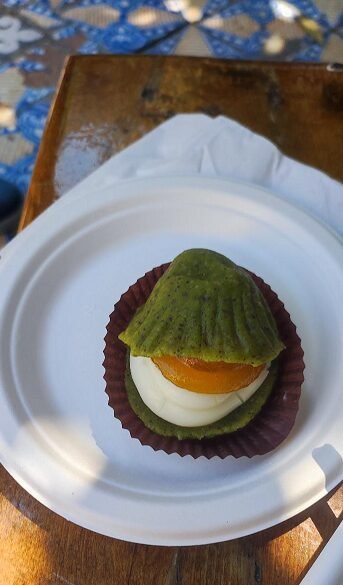
“You have to try this one,” I said, pointing to the little green pastry in the display cabinet.
My family looked unconvinced.
They had sensibly ordered cannoli.
I had chosen something called Fedda del Cancelliere — The Chancellor’s Bottom.
Not exactly the sort of name you expect to find inside a convent.
Hidden within Palermo’s former Convent of Santa Caterina d’Alessandria is a small confectionery bakery where centuries-old recipes have quietly found their way back to life.
The convent itself is magnificent, but it was the pastries that had drawn me there. Long before cafés lined the city’s streets, cloistered nuns were creating elaborate sweet treats behind these walls, selling them through discreet windows to Palermo’s elite families to support their convent while rarely stepping outside themselves.
Many of those recipes where only passed on my word-of-mouth to guard them from being used by others, and largely disappeared as convents closed.
A handful survived.
This was one of them.
I carried my little green Fedda del Cancelliere into the convent courtyard, where we found a table beneath the shade. The floor beneath our feet formed a patchwork of blue-and-white ceramic tiles, interrupted here and there by whatever replacements had been found over the centuries. Many of the original tiles had been worn smooth by countless footsteps, their glossy glaze long since surrendered to time, the terracotta underneath emerging in places.
In the centre of the square courtyard, a fountain sent a constant ribbon of water into the summer air. Around the edges stood old medlar trees—fruit that once appeared frequently on medieval tables but is now rarely seen—alongside fragrant orange trees. In one corner, rather unexpectedly, a small cluster of banana plants reached skywards, looking slightly out of place among so much history.
Pigeons wandered confidently between the tables, pecking enthusiastically at fallen crumbs beneath signs politely asking visitors not to feed them. Naturally, the pigeons seemed entirely unconcerned by the rules.
It was the perfect place to stop for an hour.
Only then did I discover why the mounded little cake, Fedda del Cancelliere, had its extraordinary name.
Despite living in a building called The Chancellor at the time, the name developed into an irreverent joke dreamed up by mischievous nuns. It is believed to be a playful reference, not to their home, but to Matteo d’Ajello, the Grand Chancellor of Sicily in the twelfth century—a powerful man whose generous appetite, and equally generous waistline, became the subject of local humour.
The earliest versions of the pastry were apparently moulded into rounded domes that left very little to the imagination.
Over the centuries, eight and a half to be exact, modesty appears to have prevailed. Today’s version is shaped like two scallop shells pressed together, making the joke considerably more discreet while allowing it to survive.
As for the pastry itself?
It was unlike anything I’d tasted before.
The outer shell is made from pistachio marzipan, rich with almonds and crushed pistachios. Inside sits a layer of silky white custard, brightened by a spoonful of apricot jam that cuts through the richness at exactly the right moment. It is dense, sweet and unapologetically indulgent—the sort of confection you eat slowly rather than absent-mindedly.
Before leaving, I bought the convent’s recipe book, entirely in Italian. My spoken Italian still leaves plenty to be desired after all these years, but recipes have a language of their own, and this one was coming home with me.
I also couldn’t resist buying another famous convent pastry called Minne di Virgini—the Breasts of a Virgin—a perfectly respectable Sicilian sweet that looks exactly like its name suggests, complete with a bright red cherry balanced on top.
That, however, is a story for another day.
As I sat listening to the fountain and watching the pigeons continue their determined search for illicit crumbs, I found myself thinking less about the pastries than about the women who first created them.
Generation after generation measured almonds, stirred custard, filled moulds for Fedda del Cancelliere and quietly passed recipes from one pair of hands to the next. Many of those women never saw much of the city beyond the convent walls, yet within those walls there was joy, and creativity, and humour and they left an imprint on Palermo that has outlived them all.
History often survives in books.
Sometimes, though, it survives in a recipe.
And occasionally, if you’re lucky, it survives in a cake cheekily named Fedda del Cancelliere, after a Chancellor’s bottom.
If you are ever in Palermo the Secrets of the Cloister Bakery inside the Santa Catarina Convent, is not to be missed. Besides serving the best cannoli in Palermo, you may be tempted to try biting into your own Fedda del Cacelliere or Minne di Virgini.
Observation: I left Santa Caterina carrying a book I can only half read, thinking about pastries I can probably only half recreate, and already planning a return visit. Some places have a habit of sending you home with more questions than answers. Those are usually the ones worth revisiting.

Kate
Kate writes Letters from Sicily from her coastal farm on the island, where the olive trees are heavy with fruit in October, six cats supervise everything, Fergus the Jack Russell believes every visitor has arrived especially to see him, and another letter is already beginning to take shape.

