Why is food in Sicily so different to the rest of Italy?
There is a moment, somewhere between the first bite and the second, when food in Sicily stops tasting like food and starts tasting like something else entirely.
When I first moved to Sicily, I thought I understood Italian food.
I’d travelled the length and breadth of Italy over the last fifteen years of living here, including living in Tuscany for over a decade. I’d eaten wonderful pasta, good olive oil, beautiful cheeses, and more pizzas than I care to admit.
It didn’t take long to realise that Sicily was something else entirely.
The food here belongs to the island before it belongs to Italy. And that statement is very sensitive to Sicilians who strongly believe that they are not part of Italy. And having lived here for some time now, I would agree with them. They have their own language, their own culture, and their own food.
Yes, you’ll find familiar ingredients that you would find in mainland Italy, but you’ll also discover flavours and recipes that seem to come from somewhere older, shaped by centuries of people arriving on these shores and leaving behind something of themselves.
The longer I live here, the more I realise that if you want to understand Sicily, you begin at the table.
Not because Sicilians are obsessed with food, although they do take it very seriously, but because every meal tells a story about the island itself.
An island at the crossroads of the Mediterranean
Sicily sits at the centre of the Mediterranean, which means it has spent much of its history at the centre of someone else’s ambitions.
The Greeks arrived first, bringing olives and vines that still define the Sicilian landscape today. The Romans followed, but it was the Arab rulers who transformed Sicilian cooking more profoundly than perhaps anyone else.
They introduced citrus orchards, almonds, aubergines, sugar cane, saffron, rice and couscous. They mastered irrigation, allowing crops to flourish where little had grown before, and they developed the balance of sweet and savoury flavours that still appears in dishes today such as caponata.
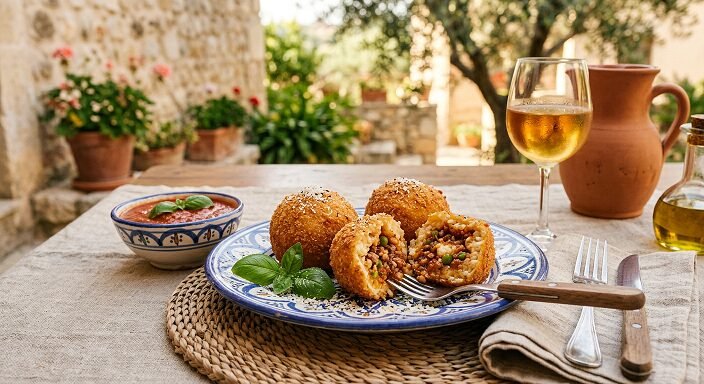
Even the humble arancini owes its origins to the Arab world. More than a thousand years later, those golden rice balls remain one of Sicily’s best-loved street foods.
The Normans added their own influences, followed by the Spanish, who introduced chocolate-making techniques learned from the New World. Those methods still survive in Modica chocolate today, where chocolate continues to be made using a centuries-old cold-processing technique unlike anywhere else in Europe.
What fascinates me most is that none of these influences replaced one another. They simply layered themselves upon what already existed.
Every Sicilian recipe is, in some small way, a conversation between civilisations.
Cucina Povera — Making something wonderful from very little
Some of Sicily’s most famous dishes weren’t created in noble households or palace kitchens. They were created by families who simply couldn’t afford to waste anything.
The Italian phrase cucina povera literally translates as “poor cooking,” but I’ve never thought that description was entirely fair.
To me, it isn’t cooking born of poverty. It’s cooking born of ingenuity.
Yesterday’s bread became today’s breadcrumbs. Those breadcrumbs were toasted in olive oil and scattered over pasta when Parmesan was beyond a family’s means. Vegetables weren’t side dishes. They were often the meal itself.
Wild fennel growing along the roadside wasn’t fashionable as it is today. It was free. And still is. Every spring we pull it out of our lavender fields by the barrowload.
Offal wasn’t something to hide. It was something to cook well.
There’s an honesty about Sicilian food that I admire enormously.
Nothing pretends to be anything other than what it is.
Pasta con le sarde, Sicily’s famous pasta with sardines and wild fennel, tells you exactly where it came from: the sea on one side, the hills on the other.
Every ingredient has earned its place.
The land still decides the menu
Living on our small farm has taught me something I never fully understood before moving here. The land doesn’t take instructions.
This summer has been particularly unforgiving.
Our cucumbers, courgettes, melons and butternut squash produced beautifully for a few weeks before quietly deciding they’d had enough. Despite watering them faithfully, they simply stopped. The climbing beans have struggled through the relentless heat, their leaves crisping around the edges. Oddly enough, the banana plants seem delighted by it all.
Nature has always had its own opinions.
This year we’ve harvested more than fifty kilograms of potatoes. Wonderful news, until you realise every one of them has to be peeled, frozen, bottled or otherwise preserved before they begin sprouting. I’ve spent many afternoons wondering whether I’d planted rather too many. When winter arrives, I’ll be grateful for every jar and every freezer drawer.
It’s a lesson Sicilian families have understood for generations.
You work with the seasons, not against them.
Our Belice olive trees produce an oil unlike anything you’ll find in a supermarket. The lemons are intensely fragrant. The cedro, an ancient citrus fruit larger than any lemon, has a floral fragrance that’s difficult to describe until you’ve tasted it yourself; sliced and then salted lightly.
Many of these flavours simply don’t travel well. Some barely survive the journey beyond the island.
Perhaps that’s another reason food in Sicily tastes different when you eat it here.
You’re tasting ingredients that were grown for flavour rather than for travelling.
Markets are still part of everyday life
One of the first things I noticed after moving here was how seriously Sicilians take their markets. They’re not somewhere to browse. They’re where relationships happen.
I’ve lost count of the number of times a stallholder has told me not to buy something.
“Not today,” they’ll say.
“Come back on Thursday.”
That puzzled me at first.
Now I understand.
They’re protecting their reputation far more carefully than they’re chasing a sale.
The market tells you what you’ll be eating that day.
Not the other way around.
Recipes are really stories
Ask someone in Sicily for a family recipe and you probably won’t receive careful measurements. You’ll hear a story instead. It almost always begins with a grandmother. There’ll be a feast day. A wedding. A harvest. Perhaps a village you’ve never heard of. The recipe itself becomes almost secondary.
Food here isn’t simply passed from one generation to the next. The memories travel with it. That’s why two people can cook exactly the same dish and somehow produce completely different results.
The ingredients matter.
The technique matters.
But so do the hands preparing it.
Eating with the seasons
Seasonal eating isn’t a fashionable idea in Sicily. It’s simply how life has always worked. When tomatoes, eggplants, apricots and plums on the farm are abundant, they’re bottled. Beans are frozen. Fruit becomes jam. The bumper crop of mulberries this year became delicious ice cream.
Our Belice Olives are both pressed and bottled.
Nothing is wasted because everyone knows the season will eventually end. I’ve come to understand this far better since living here than I ever did before.
Every summer I find myself preserving vegetables and fruit, filling shelves and freezers while quietly wondering if all the effort is really worthwhile.
Then January arrives.
I open a jar I’d forgotten about. And suddenly summer returns to the kitchen.
The soul of Sicilian food
Recipes are family histories some stretching back hundreds, if not thousands of years, like the arancini mentioned earlier. When you eat food here in Sicily you are eating a slice of history.
They are records of people making the very best of what the land offered them, season after season, generation after generation, in good times and in bad.
Every recipe carries the memory of those who came before—not because they were trying to create famous dishes, but because they wanted to feed the people they loved with what was available.
Perhaps that’s why Sicilian food feels different. It isn’t only the fresh ingredients. Or the influence of history. Or even the varied landscape.
It’s the knowledge that every dish has come through time belonging somewhere.
And here, on this extraordinary island, that somewhere still feels wonderfully relevant.
Continue Exploring:
If you enjoyed this article, come and join our Letters from Sicily subscription.
- Modica Chocolate →
- Palermo Convent Pastries→
- Sicilian Street Food
- Traditional Sicilian Recipes
- Olive Oil in Sicily
- Sicilian Citrus